
”Here Comes the Sun”: Solar’s triumph and why it changes everything
I am, quite honestly, in awe of solar. Because somewhere along the way (quietly, steadily, and far faster than anyone predicted) solar power took over the world. It has won. Full stop.
Today, around 80% of new electricity demand globally is being met by solar. Not because it’s green. Not because policymakers forced it. But because it’s better. Cheaper. Faster to build. Deployable almost anywhere.
The speed of change is one of the most remarkable shifts in our energy history, and I think it deserves to be acknowledged and celebrated.
So this month, I want to pause and give solar panels the credit that they're due. I want to reflect on how it rose, what it changes for the world, and why it forms the bedrock of the energy transition we’re investing in today.
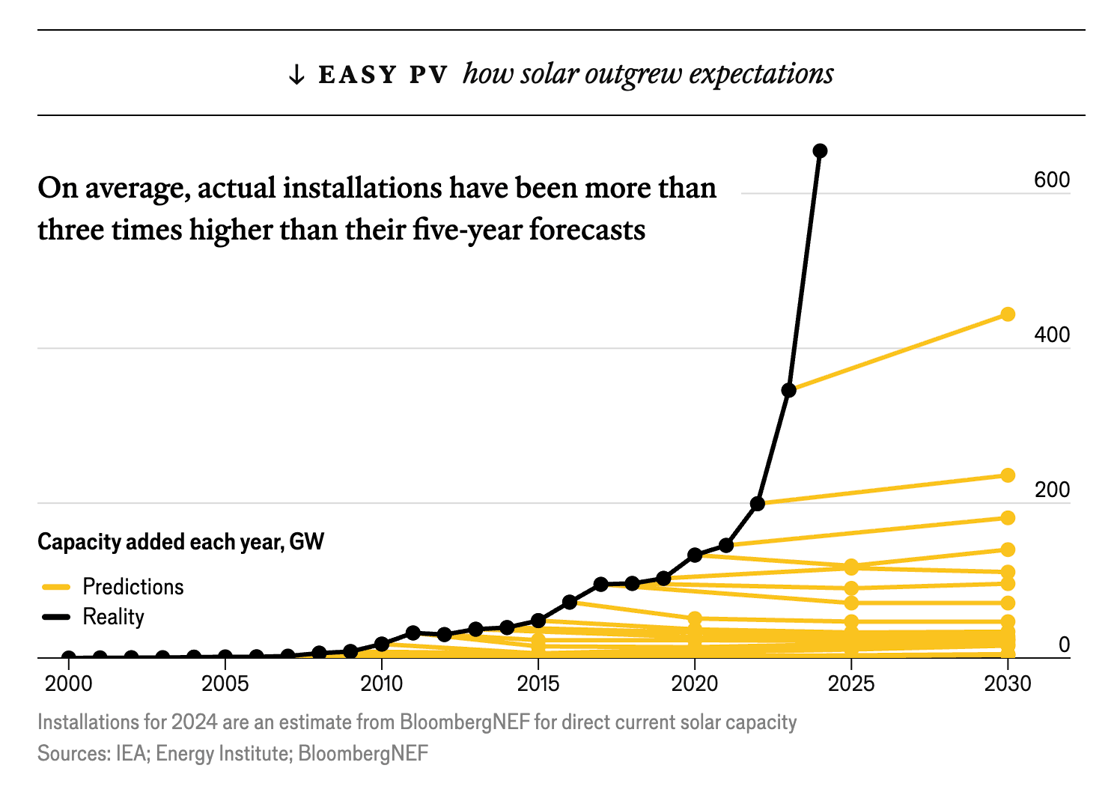
Solar power is taking over our energy systems, and is doing so much more rapidly than any expert predicted.
Solar may only account for about 6% of all electricity generation today, but the direction of travel is unmistakable. Solar capacity has been doubling roughly every three years. At that pace, it could become the world’s dominant power source much earlier than most models ever assumed, even by the mid-2030s.
To understand the speed of this shift, consider this: in 2004, it took the world a full year to install a single gigawatt of solar power. Six years later, that same amount took one month. By 2016, a week. And in 2023, there were days in which a gigawatt of solar was installed in just 24 hours. This year, analysts expect up to 655 gigawatts of new solar capacity: the equivalent of building the entire global solar system of 2004 twice, every day.
What’s even more compelling is that this is not limited to wealthy countries. One of the most striking examples of this acceleration is Pakistan. Despite economic challenges, Pakistan imported 17 GW of solar panels in 2024 alone (that’s 36% of total electricity generation capacity in the whole country!), making it the third-largest solar-panel importer globally. The boom is fueled by plummeting costs of Chinese solar panels, while electricity prices in Pakistan have skyrocketed (up 155% over three years). Even more interestingly, the Pakistani solar boom appears to be a bottom-up transformation as almost none of it is in the form of big solar farms. It demonstrates that when economics align, people will adopt renewables simply because it’s the better option.
Solar (alongside wind) is now growing so fast that, so far in 2025, it has even outpaced total growth in electricity demand. That means renewables aren’t just keeping up; they are eating at grey power. They’re starting to push fossil fuels out of the system!
Solar power has become the cheapest source of energy in the history of the world, and is poised to get cheaper still.
The biggest driver of solar’s rise is beautifully simple. Unlike fossil fuels, whose resource base gets harder to exploit over time, solar power becomes cheaper and easier the more we build. Solar panels follow a “learning curve”. Every doubling of production has historically reduced costs by about 20%. And because the amount of solar power the world installs keeps doubling every 3 years, the cost keeps falling.
Once solar edged close to cost parity with fossil electricity, its true nature revealed itself. Solar is modular. You can produce millions of identical panels, test them, tweak them, learn from them, and almost instantly apply that learning to the next batch. Modularity creates steep learning curves, and steep learning curves bring fast cost declines.
Since the first commercial panels in the 1960s, the cost of solar power has fallen more than 1,000-fold. Today, 90% of new renewable projects are cheaper than their fossil fuel alternatives. In some cases, dramatically so. Solar-plus-battery systems are now competitive with gas plants, thanks in part to lithium-ion battery prices tumbling 89% since 2010.
This changes everything, not just how we produce the electricity we use today, but also the business case of electrification.
We're headed toward a world of genuinely cheap, abundant energy. And when electricity gets cheaper, everything built on top of it does too. A decade ago, only about 25% of global energy demand could realistically be electrified. Today, the proportion of final energy demand that can be electrified economically is 75%. And given further expected price declines in solar and batteries, and further technological developments in technologies like electric motors, heat pumps and heat batteries, this number is expected to increase further.
Suddenly, electrification no longer feels like an environmental aspiration. It is becoming the smarter business case. Solar’s success isn’t just swapping out coal plants. It's reshaping the economics of the entire energy system.
We're still early in this story.
Even with all this explosive growth, solar power's takeover is just getting started. It’s still early in its total addressable deployment.
The constraints today don’t sit with solar power but with the systems around it: limited grid capacity, slow storage expansion, concentrated supply chain, and the digital systems needed to manage a highly distributed energy network. These are real hurdles, but they are engineering ones, not limits of nature. And engineering challenges are solvable, especially when the economics line up, as they are now. Each bottleneck creates its own wave of investable opportunities.
Around solar’s success, the value chain is expanding: grid integration, energy management, storage, advanced materials, and the software that binds all of it together. These tend to be scalable businesses, and they will form the backbone of tomorrow’s economy.
For an extra dose of solar optimism
I hope this short exposé has gotten you as in awe and excited about solar’s success and potential to drive the rest of the energy transition forward as me. But if you need a little more, here’s one of the most uplifting books I’ve read recently: Bill McKibben’s Here Comes the Sun. (Or this nice podcast from The Guardian with Bill). He captures the same sense of grounded optimism that I feel when I look at the solar curve: a recognition that climate action and economic opportunity can reinforce one another, and that we are living through a once-in-civilization shift.
Solar is not the whole story of the energy transition, but it is the foundation on which much of the rest will be built.
🗞️ Carbon Equity Update
We are proud to announce that we have brought on board a couple of strategic partners as new shareholders. Next to the Netherlands, Belgium, and France, they are coming from Germany and Switzerland. This makes our shareholder base truly pan-European.
From day 1, Carbon Equity has been backed by top entrepreneurs and leading family offices alongside top venture capital funds. Today, 6 new entrepreneurs and 5 new family offices are joining the company as mission-aligned shareholders. Our current investors, 4impact capital and BlackFin Capital Partners, are also putting in additional capital to help us grow further.
Since the start in 2021, it has been our mission to mobilize private capital to help solve the world's biggest challenges. So far, we have already funded 250+ climate solutions and onboarded more than 1.500 investors onto our platform, who collectively committed over €350 million. This step enables us to accelerate the transition and move towards realizing our vision.

💡 News from within our funds
- ♻️ Redwood announces $350M Series E funding and has begun operations at a $3.5 B factory in South Carolina
- 🏠 1Komma5 to build solar systems on 560 state buildings in Germany
- 🛵 Vammo raised $45M to expand manufacturing and to boost the firm’s presence in Sao Paulo
- 🌬️ XNRGY opens manufacturing facility Mesa 1 for data center cooling solutions in Arizona
- 🔋 Form Energy’s first 100-hour batteries are hitting the grid
- ☢️ Crusoe taps Blue Energy to supply nuclear power for up to 1.5GW data center in Texas
- 🤖 Altrove raises $10M to accelerate AI-designed alternatives to critical materials
- 🧱 Rondo Energy and Heineken in partnership to build one of the largest heat battery systems in Portugal
- ⚡️ Sunfire partners with Rheinmetall to set up a Europe-wide network for decentralized production plants of e-fuels
- 🌱 Source.ag raises €15M for applied AI in CEA, pushing total funding past €52M
- 👕 Syre announces multi-year agreement with Nike to scale circular polyester
- 🛢️ LanzaTech secures €40 M EU Innovation Fund Grant
- 🚚 Harbinger raises $160 M in Series C funding co-led by FedEx, Capricorn and THOR
Already investing with us? You can now follow the latest news on your personal investments directly on our platform, here.
📚 Interesting reads
Global investors are pouring more money into climate tech
This Bloomberg story highlights that global investment in climate tech has rebounded and now sometimes surpasses levels seen before the Trump administration. Despite political volatility, capital is flowing into energy, mobility, storage, and industrial-tech solutions at accelerating pace.
This NRC article reports that China’s CO₂ emissions have been flat for a year and a half, driven by explosive growth in renewables, EV adoption, and slowing heavy-industry output. It raises the possibility that China (the world’s biggest emitter) may have passed its emissions peak earlier than expected.
Geothermal energy looks set to go from niche to necessary
This Economist piece describes how geothermal is shifting from a niche resource to a core pillar of the clean-energy system, driven by breakthroughs in drilling, enhanced-geothermal technologies, and falling costs. The article argues that geothermal’s always-on baseload power makes it uniquely valuable as grids electrify.


