
How to solve battery demand without digging deeper

Earlier this year, China once again tightened its grip on the world’s rare earth supply. A sharp reminder of the risks tied to today’s battery supply chains. So in this month's edition, I wanted to explore how innovation is reshaping the battery supply chain. From smarter mining and battery recycling to new chemistries and increasing battery energy density, here's how climate tech companies are helping us power the energy transition without digging ourselves into a deeper hole.
Read full article by Idse Luirink
The article is inspired by the brilliant work from RMI and Daan Walter. Read the full report.
Where we are at: in short
🔋 Battery demand is surging: up 33% per year for the past 30 years, and still climbing.
🪨 As a result, demand for key minerals is also rising. These include lithium, cobalt, nickel, and graphite.
🌍 Mining and refining of these minerals is concentrated: China holds a ~ 70% share across key minerals, and serves as the world’s go-to processor for 19 out of the 20 critical materials.
⚠️ This concentration brings geopolitical, environmental, and social risks. Innovation across the battery value chain is needed to help address them.
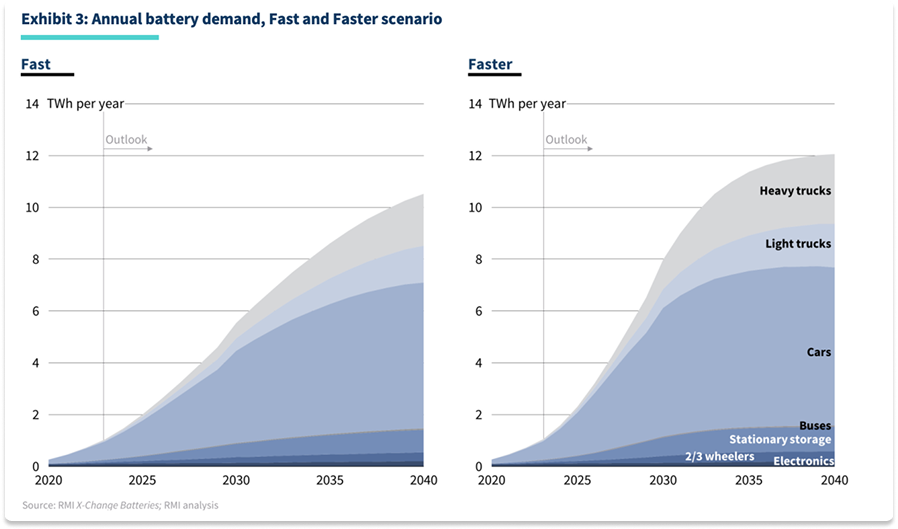
As the chart above demonstrates, the lion’s share of battery demand stems from electric vehicles, followed by stationary battery storage to stabilise grids powered by solar and wind. Only a small portion of demand will come from consumer electronics.
More and more, this skyrocketing demand is revealing just how vulnerable our current mineral supply chains are.
Diversifying supply chains will be important to reduce dependencies, but it is not as simple as opening new mines and refineries elsewhere. New projects come with long lead times and often still cause serious environmental and social damage.
This is why we must meet growing battery demand with as few new mines as possible. The long-term end goal should be a fully circular battery economy. Encouragingly, new solutions are helping reduce supply chain vulnerabilities and the environmental impacts of extraction. Key advances include improving mining practices, scaling battery reuse and recycling, increasing battery energy density, and developing new battery chemistries.
Solutions across the battery supply chain
1. Smarter mining with a lighter footprint: Companies like Ceibo and Lithios are rethinking extraction by cutting water use and unlocking low-grade ores with clean-tech processes. Making it possible to extract minerals with less environmental damage and fewer resources.
2. Scaling battery reuse & recycling: We can already recover up to 95% of critical materials from used batteries and companies like Redwood Materials recycle lithium-ion batteries and produce high-quality materials with up to 80% less energy and 70% fewer emissions than mining (as proven by U.S. DOE lab tests). Others like Stabl give EV batteries a second life as modular storage systems before recycling, cutting costs and material demand.
3. More energy-dense batteries: Higher energy density means batteries can do more with less, reducing the amount of material needed per unit of storage. Adden Energy and Group14 are leading here with solid-state and silicon-enhanced tech.
4. Better battery chemistries: Some innovators are ditching hard-to-source minerals altogether and are creating batteries with more abundant, less rare, materials. Inlyte and Form Energy are building long-duration batteries from abundant materials like iron and sodium.
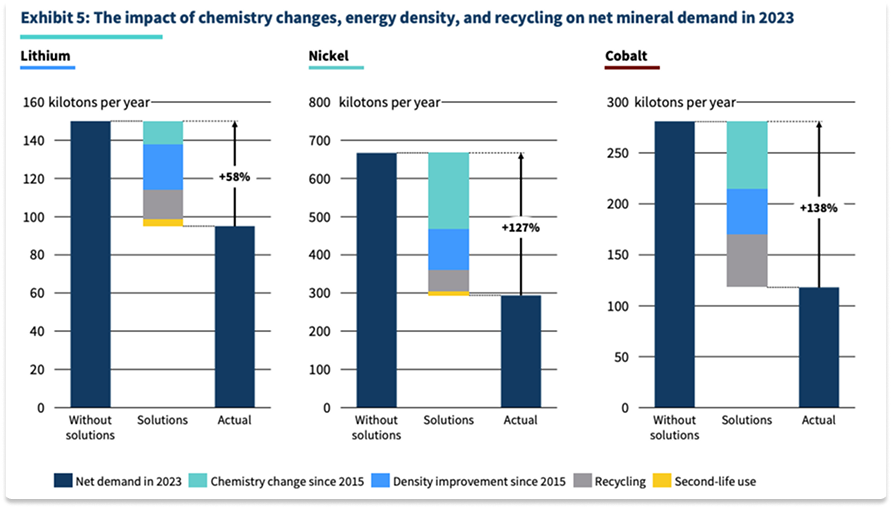
Thanks to these types of innovations, we’re already using far fewer critical minerals for batteries than we otherwise would. If we had stuck to 2015 technologies, demand for nickel and cobalt would be 2x higher today and lithium demand would be up 58%, as showed below.
♻️ A circular battery future is within reach
So the long-term strategy is clear: minimize new extraction and improve current mining practices, moving towards a system that doesn’t depend on digging deeper every year, but on getting smarter about what we already have. We're not there yet but the current trends show that:
🔋If they continue, global demand for virgin battery minerals can peak by the mid-2030s.
♻️ After that, as recycling scales, battery designs become more efficient, and new chemistries reduce the need for scarce minerals, the net demand (meaning total demand minus recycled supply) starts to drop. According to RMI, net zero demand could even be achieved before 2050.
🇨🇳 China might get there even earlier. CATL’s founder says the country is on track to eliminate new battery mineral extraction by 2042 thanks to its booming recycling market.
Yes, we’ll still need around 125 million tons of minerals to electrify everything. But we’ll replace over 2,150 million tons of oil burned every single year. And unlike oil, minerals don’t go up in smoke. They can be reused again and again.
By taking a holistic approach with better mining, greater reuse and recycling, and smarter batteries, we can design battery supply chains that are more resilient, more local, and more fair. This allows us to unlock the full potential of electrification without creating a new form of extraction dependence. The energy transition should aim not only for cleaner power, but also for smarter systems.
💡 News from within our funds
⚛️ Radiant raises $165M to bring its portable microreactors to market, aiming to decarbonize remote and off-grid energy.
🔋 ABB launches battery-as-a-service with GridBeyond to scale flexible storage for commercial and industrial energy users.
🏗️ Sublime Systems signs landmark deal with Microsoft for long-term clean cement supply.
💨 Electric Hydrogen’s HYpRPplant tech tapped by Infinium for green e-fuels, pushing forward decarbonization of hard-to-abate sectors.
🔋 Group14 and BASF join forces on market-ready silicon anodes designed for extreme durability in next-gen lithium-ion batteries.
✈️ Metafuels to build Rotterdam plant for e-SAF, targeting production at scale in partnership with SkyNRG.
🔥 Fervo Energy gets approval from Nevada for Clean Transition Tariff, paving the way for more geothermal power in the U.S. grid.
Investing with us? You can now follow the latest news on your investments directly on our platform, here.here.
📚 Interesting reads
A Grid Turning Point: Fossil Fuels Dip Below 50% in U.S. Electricity Mix
For the first time ever, fossil fuels generated less than half of U.S. electricity in a single month. This new record shows renewables aren’t just growing: they’re winning. A must-read milestone for those interested in the acceleration of clean energy markets.
London Stock Exchange puts value of global green economy at $7.9T
Revealing that over 9,000 companies (worth a combined $9 trillion) are driving the global green transition. From clean energy to circular economy plays, this “hidden” sector already makes up 7.6% of the global market cap.
Offshore wind back online in the U.S
After months of uncertainty, the U.S. just gave the green light for Equinor’s Empire Wind project to resume construction. One of the largest offshore wind farms in New York, it’s now back on track.
Where climate tech is heading next
SVB’s Future of Climate Tech report offers a goldmine of insight into how capital is flowing into sectors like e-fuels, geothermal, food systems, and industrial decarbonization.


